| Want to send this page or a link to a
friend? Click on mail at the top of this window. |
| This column is, current as of this month,
May
2011. |
| First published September 18, 2001 |
| United States of America Must Wipe Out the Terrorists and Their
Sponsors |
CAMBRIDGE, MA. - A military adage holds that a man under fire will show the best
or worst side of his character. Judged by that standard, Osama bin Laden, 45, a Saudi
Arabian native commander-in-chief terrorist who operates terrorist bases and training
camps in southern Afghanistan - one of the three hungriest countries in the world,
according to a last year published United Nations (UN) report - and has been indicted by
the United States for the bombing of two of its embassies in the African
countries of
Tanzania and Kenya in 1998, killing over 200 people, most of them Africans, allegedly once
again came out by proxy, but this time on Sept. 11, 2001, showed the best of himself.
Shock struck the United States and the rest of the civilized world on that early morning
of September (The date coincided with Sept. 11, 1922, when a British mandate came into
force in Palestine, over the heads of unyielding Arab opposition) after bin Laden's
followers or bandits first hijacked two American commercial jets full of fuel and then
simultaneously commandeered them to attack the crowded World Trade Center twin towers (two
of America's symbols of economic power) in New York City, home to men and women of every
faith from some 60 nations and
countries, felling both structures. Thousands of innocents citizens lay
dead in the wreckage of the buildings and thousands more suffered injuries.
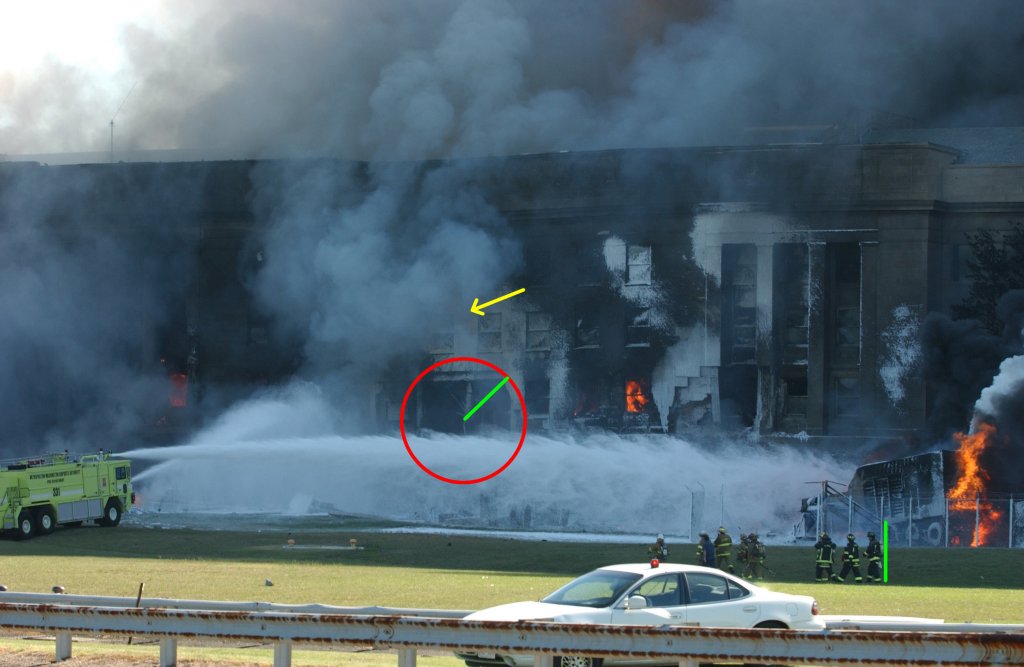 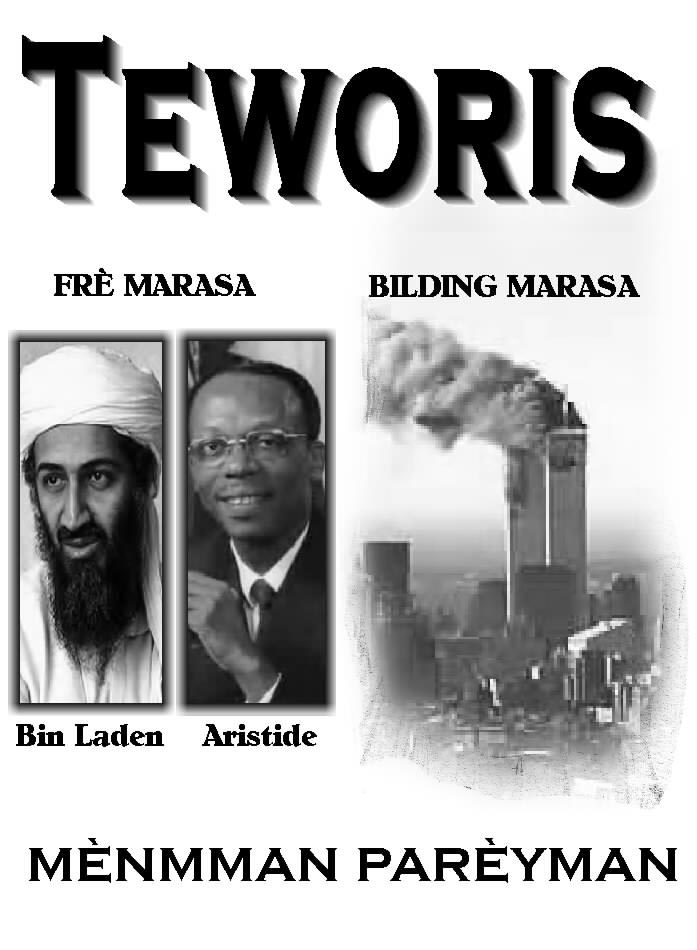 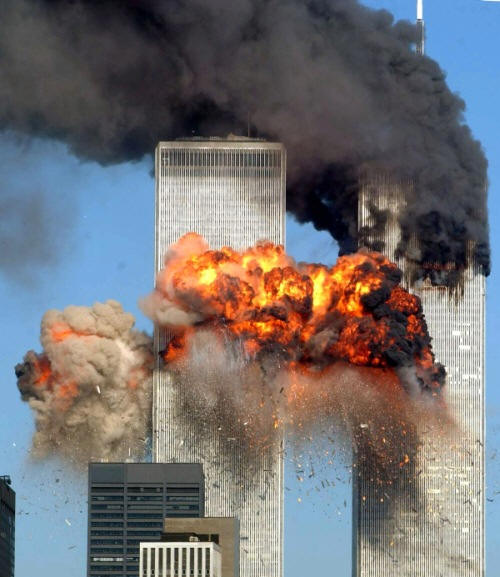 |
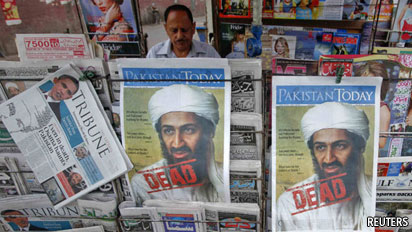
THE FACES, THE IMAGES OF TERROR ABOVE
The burning Pentagon building (L), the symbol of the United States of
America military power, in the early morning of Tuesday, September 11,
2001. The World Trade Center buildings (also center-right) that were
consumed by ferocious flames in New York City; the words in the Haitian
lingo Creole literally read as such: Terrorists, twin brothers in crime,
twin buildings, and the same men; Osama bin Laden (with long beard),
captured dead by a team of 30 to 40 U.S. special force's commando,
Navy Seals, on Sunday, May 1, 2011
(United States' calendar day), in the Pakistani mid-size city of Abbottabab, about an hour drive from the capital of Islamabad;
in the
subsequent picture,
Jean-Bertrand Aristide, in fancy suit of the color black, captured alive
by United States' special forces on February 29, 2004 before he was forced into
comfortable exile, mainly in South Africa after a brief stay, first in
Central African Republic, a landlocked country in central Africa; then,
Jamaica.
Bin Laden murdered more
than 3,000 innocent people in New York City (World Trade Center) and at
the Pentagon, in Washington, D.C., on Sept. 11, 2001. Aristide, a well
known alleged
drug lord, who continues to claim to be Haiti's
president, despite the fact he was elected in a largely fraudulent
election, has
burnt alive an innumerable number of his fellow Haitian
compatriots. |
An hour later or so, hundreds more were consumed by ferocious flames after a third hijacked
American commercial plane ploughed into the Pentagon, America's symbol of military power,
in Washington, D.C. But the fourth hijacked commercial airliner, apparently aimed at the
White House, crashed into a field in Pennsylvania, causing all of its passengers,
including the hijackers, to loose their lives.
Now comes the issue of measuring the economic loses - though no model has been built to
determine the statistical relationships between both, the dependent variable Y, which can
be defined as: the United States economy, and the x independent variables, such as:
airlines and real estate industries - caused by the worst terrorist acts ever in the
annals of the modern world. How big a blow? The ordinary business of life - airline
flights, sporting events, shopping malls, stock markets, etc. - in the United States was
shut, suggesting that billions of dollars in revenue were lost.
Billions of dollars more are likely to be lost in the weeks or months to come as
confidence in the economy remains an issue of concern. Ford Motor Corp., for example,
warned that profits would be just half of what had been expected before the attacks for
the third quarter. Analysts now expect Knight Ridder Inc. to earn 65 cents a share, down
from earlier expectations of 80 cents. And Dow Jones & Co. to earn 19 cents a share,
down from 29 cents during the second quarter.
The current hit to corporate earnings, adding to the airlines companies that have been
forced to be on the verge of bankruptcy since four of their planes were hijacked by the
terrorists, causing citizens to continue to be afraid to fly, forcing executives to
struggle to keep them afloat by stepping up their pleas for immediate financial assistance
from the federal government that goes beyond grants and loans to include liability relief,
as insurance companies are in the process of squeezing their premiums and significantly
reducing coverage, could prompt to even more layoffs, in addition to the 20,000 or so
already announced by the airlines industry, as well as significantly reducing capital
spending, as companies struggle to bring costs into line with lower demand for goods and
services.
Cynics may not agree with the author of this column. But all of the above relevant factors
analyzed give real cause for concern, suggesting that since the Sept. 11 attacks the
United States' economy is no longer having a hard time landing, it will, in the near future,
not escape a recession, defined as two consecutive quarters of falling growth GDP.
Depending on the nation and country, recession might therefore be when the growth rate falls
significantly, say, by at least two percentage points below its long-term potential,
causing unemployment to rise. For example, Morgan Stanley, including the International
Monetary Fund (IMF), uses weights based on countries' GDP measured at purchasing
power-parity (ppp), which adjusts for differences in price levels between
nations and countries. J.P.
Morgan uses weights based on GDP at markets exchange rates. The ppp gives far more weight
to emerging economies, such as those of Colombia, with a projected GDP of $106.3bn
for the year ending Dec. 31, 1998 and the Bolivarian Republic of Venezuela $110.2bn,
according to the Economist Magazine (The World in 1998).
What exactly are the new set of problems that will be created by a recession - even if it
is just a growth recession? The explanation for the latter is that the economy grows, but
at a rate below the long-term trend of 3 percent. Whatever the case, the unemployment rate
will rise and business and personal bankruptcies will increase as less and less money is
collected in the form of federal taxes by the United States' government. And this, in spite
of a ten-year cumulative budget surplus of $3.4 trillion - a brave assumption - produced
by the
American Congressional Budget Office (CBO) in August.
With a little further tinkering, guided by the combination of a slower economy,
anti-terrorism spending, airlines bail-outs, to include the tax cuts already slated for
fiscal year 2002, the surplus, which in May was first forecast at $5.1 trillion (4.1 of
GDP), will most likely be sliced even thinner, driving the officially measured budget
toward a deficit during the fiscal year 2002 and many other years to come.
The author's most pessimistic view is not the definition of the big "R" word or
recession. So, too, it is not the anticipated resulting problems just enumerated and
analyzed above. But from a hypothetical perspective, a prolonged 1-point increase in the
national unemployment rate, on a scale running from 5 percent to 6 percent, will promote
social problems. The most common social problems may be defined as: suicides, homicides,
domestic violence or divorces, homelessness, child delinquency, fatal heart attacks or
strokes, deaths from liver cirrhosis, admissions to mental hospitals, and admissions to
state prisons, as citizens commit more crimes for a variety of reasons. For example, many
new unemployed people will steal goods from department stores they do not have money to
purchase. Others will break and enter homes and end up killing the victim(s) to avoid
detection.
To assume that the number of crimes now being committed by citizens will go upward and
their economic costs to the taxpayers will be highly correlated is a great leap of logic.
But the economic costs of public wrongs, or acts prohibited by the state, will be hardly
to measure accurately. However, one may use current or previous United States' government
relevant expenditures to demonstrate that there will be a significant increase in
crime-related expenditures - they will most likely total many billions of dollars
annually.
Yet the Sept.11 unspeakable (political) crime also came at such a fragile moment for the
rest of the industrialized world economies, which already were having a hard time escaping
an official recession. It presented them all and others with enormous economic loses since
the combined revenue generated by many multinational corporations and foreign
nations and countries -
the latter through taxes paid, for example, in the form of sales, personal and corporate
taxes, etc. - intersect with the performance of the United States' economy.
And consider the New York City's economy itself - the most hardly hit. The question that
Mayor Rudolph W. Giuliani and New York state Governor George W. Pataki are soon going to
have to address is: will the economy of that city recover in the short-run to its
pre-Sept. 11 terrorist acts place in the American economy, or whether it will enter into a
downward spiral?
The question is worth asking. New York City's greatness is determined by a circular
causation. How so? This can be best explained by its people and businesses. They
locate there, after all, because of the economic opportunities created by the presence of
other people and businesses.
Assume a substantial number of New York City' s people, all traumatized by the Sept.11
terrorist acts, decide to depart the city. Businesses, too, no longer want to remain there
because other businesses are leaving; they are also concerned about future terrorists acts
and fear the consequences for their future effectiveness. It would not be wrong to
conclude that the local economy will most likely fall below critical mass and enter a
downward spiral.
| The terrorist acts, a "declaration of war" |
The appalling atrocities of Sept. 11 must be seen as a declaration of war, not just
on the United States but on the rest of the civilized world, which is not limited to
France, for example. They must also be seen as an anti-democracy and capitalism
declaration, especially "anti-democracy." The United States' government, together with
Congress, will be forced to come up with new legislation in an effort to minimize the
possibility of future terrorist acts. Because of that, citizens will be deprived of some
civil liberties that they now enjoy.
 |
|
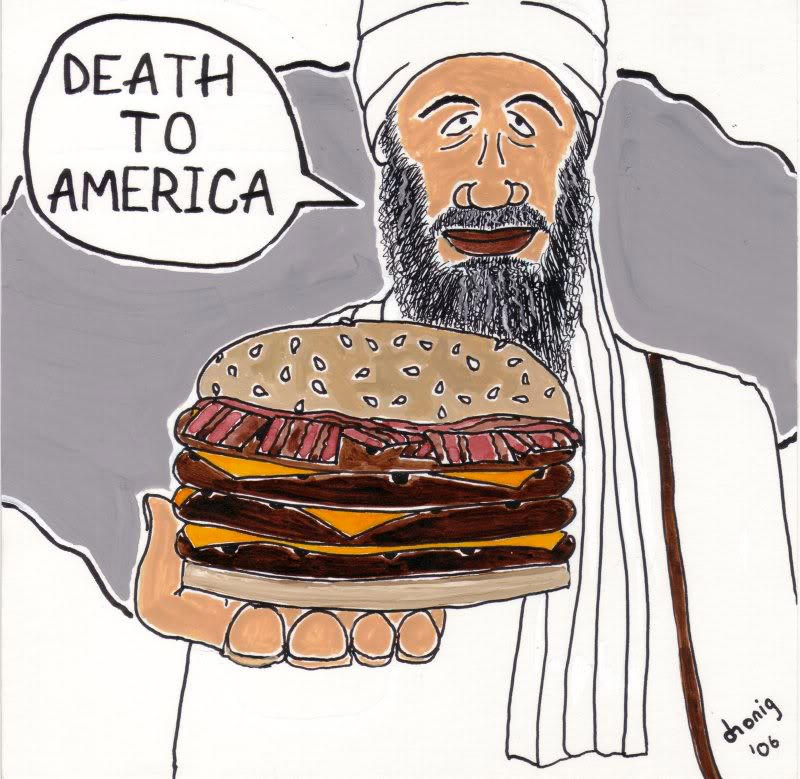
EMBLEM OF EVIL
Soon, certainly
no more "Death
to America," at
least from you
Osama. (Caricature
may be
copyrighted) |
|
That seems unlikely this time. But assuming that the United States - leader of the first
world, not an island of prosperity - decides to deal with terrorists rather than just
terrorism. Attempts are then made to capture bin Laden, the prime suspect, while
ignoring his vast terrorist networks and others. He shoots himself to death or
fatal shots are pumped into his body in the process. His death will certainly promote him, as he always envisions,
from leader to martyr.
The
history of the free world must not be written by Islamic fundamentalist groups, including
bin Laden. Tragically for Islam, a 1,400-year-old great religion that literally means
"surrender," these groups and bin Laden base their actions on a surah in the
Koran, a verse that reads: "Fight in the way of Allah against those who fight against
you, but begin not hostilities. Lo! Allah loveth not aggressors. And slay them wherever ye
find them, and drive them out of the places whence they drove you out, for persecution is
worse than slaughter." However, to many Islamic scholars those teachings simply
authorize violence just in self-defense.
What's more, history of the free world must neither be written based on the teachings of a 14-century
firebrand, Ibn Taymiyya, who stated unequivocally, "jihad," which literally
means struggle, "against the disbelievers is the most noble of actions."
|
___________________________
|
| |
"Those who are attempting to
help the totalitarian world achieve democracy or
a sense of civility cannot be wrong, but only
those who have failed to even attempt to help
the totalitarian world achieve democracy or
sense of civility are proceeding to retard the
course of history and certainly prolong the
extreme suffering of victims," Yves A. Isidor
Source: Amnesty
International Human Rights Report 2004, via
Wehaitians.com |
|
___________________________
|
One can only say that the history of the free world must, rather, be written by democratic
nations and countries. The United States, in concert with its allies, must muscularly respond (A
campaign that must also be waged on the diplomatic and ideologically fronts) to the early
last week attacks on New York City and Washington, D.C., destroying as many of these
extremely violent, criminal groups as possible."
Still, there will be possibilities. The United States and the rest of the civilized world
should not be naive enough to say, with confidence, the terrorist groups, including just
conceived home-grown lunatics, will not attempt to avenge the destruction of their
partners in crime. Since it is so, the United States and the rest of the civilized world
will have to supplement their high-technology intelligence gathering snooping for
counter-terrorism, which depends on pooling on information and also requires international
co-operation, with human intelligence or spying to help meet future enemies' threats.
Who have long been backing, at least financially, the Islamic fundamentalist groups?
Certainly a handful of totalitarian dictators in the Middle East. Wiping out as many of
these evil dictators and their governments, too, will (hopefully) play a role in helping
the countries they have long turned into pariah states to progressively achieve democracy.
The cold war may have long been over, suggesting that there have been a misunderstanding
human nature, believing that foreign policy should not rate high - say, on a scale of zero
to ten. However, the dilemma of a new type that the United States was presented with on
Sept. 11, of course, not only suggests that it is still as important as it was before the
collapse of the Soviet Union, but a re-assessment of it is long over due. In so doing, the
United States will not only fully comprehend why anyone should be moved by such hatred
against it, but be better prepared to deal with "terrorists' suitcases," for
example - a new "Damocles sword" hanging over the civilized world and democracy.
  |
| Brignol Lindor (L), a provincial radio journalist hacked to death by brutal
dictator Jean-Bertrand Aristide on December 3, 2001. Mireille Durocher
Bertin, a prominent Haitian attorney who vowed to have totalitarian
dictator Aristide face the bar of justice for repeatedly violating the
1987 Haitian constitution by affixing his signature at the bottom of
documents while in forced exile in the United States authorizing the
latter nation's troops to invade Haiti so he could thereafter regain the
presidency he lost in a late September 1991 military coup d'état
or what many rather referred to as "democratic correction,"
was
gunned down on March 28, 1995 in broad daylight on the
Port-au-Prince working class street of Ruelle Chrétien. |
As the United States and its allies are preparing to embark
on an unprecedented campaign to write the obituary of many terrorist groups, especially
that of bin Laden, they must not forget about Haiti's chief bandit and radical leftist
Jean-Bertrand Aristide who on Sept. 7, four days before the assault on the United States
and democracy, told Haitians gathered at the Port-au-Prince's only soccer stadium for a
make believe public illiteracy meeting "The little bird is going to show the big bird
what he can do." What exactly was he saying? The small country or dirt-poor,
tribal
Afghanistan, but through bin Laden, is going to show the big nation or the United States
what it can do.
No wonder the current economic conditions, too, in these countries will (hopefully) change
for the better since the "grand thieves" will no longer be in power to pocket every single penny and dime to pay for the cost of
carrying terrorist activities around the world, further inflicting pain on peaceful
citizens and their governments they often regard as "Great Satans," as the
contents of their speeches indisputably suggest.
Days after devastation visited Lower Manhattan and Washington, D.C., in the United
States the mood is grief, purpose, unity, anger, and outraged patriotism with talk
of war. The explanation for the latter is that even avowed non-pacifists would agree with
St. Augustine's contention, a fourth century Christian philosopher, who said "The
greatest danger of war is not the physical harm that it causes but the passions that
it inspirers."
On behalf of the vast majority of the Haitian people, who dream of a
democratic Haiti, and "We Haitians United We Stand For Democracy," I convey my
expressions of condolences to United States' President Georges W. Bush and his fellow compatriots.
|
And now, dead,
|
| |
|
|
| after a few bullets were enough. But
the shots that killed Osama bin Laden in the
dead of night on May 2nd in a fortified compound
not far from Islamabad, according to the
Economist Magazine of May 5, 2011, came after 15
years of dogged pursuit, two long wars in Iraq
and Afghanistan, well over $1 trillion of
spending and around 150,000 deaths. It is a
heavy reckoning for one man's life. |
The writer, Yves A. Isidor, who teaches economics at the University of Massachusetts-Dartmouth,
is the executive editor of Wehaitians.com
and spokesperson for "We Haitians United We Stand For Democracy, a
Cambridge-based nonpartisan political pressure group.
*This column was also published in The Standard-Times on
October 7, 2001. More, this column has been reprinted by more than 17 newspapers and
magazines in the United States, Europe, and Latin America. At least two
newspapers have translated
this column into the Spanish language and ultimately accommodated it for publication.
*Related articles:
| Wehaitians.com, the scholarly journal of
democracy and human rights |