| Want to send this page or a link to a friend? Click on mail at the top of this window. |
| First published June 18, 2002 |
| Time Magazine, please stop trashing the World Cup and Portugal |
| _________ |
| By YVES A. ISIDOR |
Cambridge, Massachusetts, June 18, 2002 - After reading Mr. Joel Stein's essay, or his piece of garbage ("The Rest-of-the-World Cup," Time Magazine, June 17, 2002), I wondered why did I spend my valuable time reading a person who seems to comprehend nothing at all other than himself.
"Last week we," a reference to the United States, "pulled off a huge victory against Portugal. It didn't make us feel that great because there's not much Portugal is better at than us, other than making sweet wine and salted cod," Mr. Stein wrote.Reading further Mr. Stein's diatribes, one would also learn "This is a country," a reference to Portugal, "that has been in decline since 1494, when in the saddest, most grandiose moment of self-delusion in history, it actually sat down with Spain and divided up the world."
Mr. Stein further argued, unintelligently so, "If the world really wants us to watch their cute little no-handsy sport, they've got to make an effort. The world has done a poor job marketing this World Cup thing to us. There's no Burger King tie-in, no campaign with Matthew Perry going Soccer Crazy as a pre-emptive excuse for going to rehab."
|
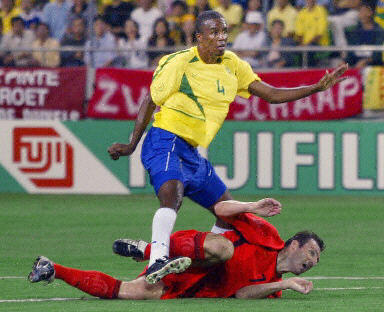
| Belgian forward Marc wilmots (down) falls after a high kick as Brazilian defender Roque Junior (top) looks on during the second round match Brazil/Belgium of the 2002 FIFA World Cup in Korea and Japan, 17 June 2002 at Kobe Wing Stadium. AFP Photo Philippe Huguen (119464) |
Mr. Stein is absolutely wrong. There are reasons for this. Visiting, even briefly, FIFA's (the world soccer authority) Web site, one would discover that a significant number of multinational corporations, including the U.S. -based McDonald's, are advertising with the world ever biggest championship, the world ever love affair sport, as more than 34 billion citizens (equivalent to five times this planet's population) from the world over, according to FIFA, who, either in part or in full, distance themselves from work and other personal daily affairs, to watch it suggest.
Mr. Stein has not thought of this, of England, for example, one of the G-8 nations. Whenever the English national soccer team looses a World Cup match, say to a Third World nation's team, the "hooligans" - as some of the English soccer-mad fans, the soccer-induced English are known - feel their team has failed to form the world's picture of their nation: an exotic, joyous Great Britain. They, in turn, take to the streets, destroying everything, including packed automobiles.
Consequently, the same may be said for exuberantly unhappy soccer fans from other major European economies because they feel that their teams have failed to convey national pride.
Mr. Stein may think that he is Mr. everything-expert - sure a retrograde mentality. But some other unsubstantiated points he raised in his so-called 'essay' would, too, hardly convince, if at all, even an elementary-school boy that he is what he pretends to be. He seems not to have ever enrolled in a basic economic course (ECO 101), not to understand world affairs and its diverse inhabitants at all.
 |
| Mattapanonline.org |
May I conclude by suggesting that Mr. Stein read some serious publications like The New York Times, The Wall Street Journal and certainly, The Economist Magazine, so, hopefully, he will, in part or fully, amass the knowledge needed before he is again afforded the opportunity to write for Time Magazine on issues, especially soccer (an international multi-billion-dollar industry that is less about money than about passion and national pride), that concern the world.
The writer, Yves A. Isidor, is an economics faculty member at the University of Massachusetts-Dartmouth, spokesperson for We Haitians United We Stand For Democracy and executive editor of wehaitians.com, a scholarly online journal.
| Wehaitians.com, the scholarly journal of democracy and human rights |
| More from wehaitians.com |